Monday, May 10, 2010

Detail Shots

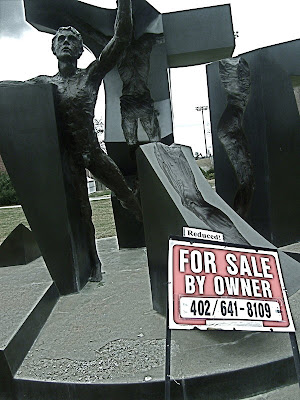
This first image was photographed by another Concordia student. This is her site. Last year, another student moved a for sale sign from someone's yard and placed it here. The artist saw this and found it humorous.

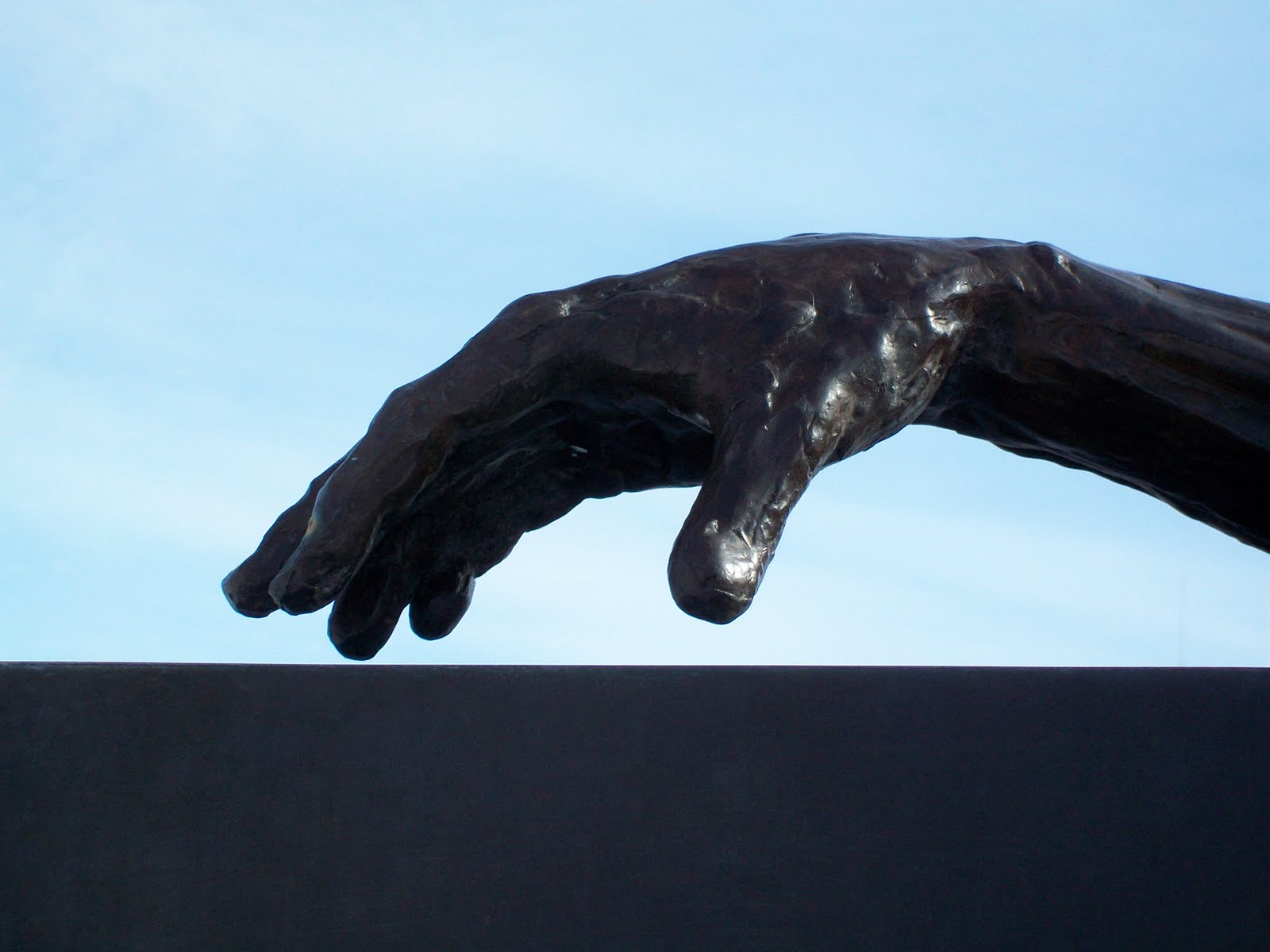
In these photos I took of The Son of Man be Free at 8:30 one February morning, you'll notice someone has put a snowball in his hand.

I didn't photograph it, but another student this year informed me that he saw a cigar placed in between the statue's fingers.

I wouldn't call these pranks graffiti, but some of them have resulted in lasting damage to the sculpture. Most likely, pranks were as common during Marxhausen's years with Concordia's art department. I wonder what Marxhausen would have thought of these pranks? Considering his comments praising the Christian-symbolism and technique of the sculpture, would he have been annoyed by this disrespect shown to an image of Christ?

On the other hand, here is something he wrote about graffiti on a wall:

The graffiti wall was the result on an uncontrolled activity. It was not planned, it broke rules...The wall is important. The wall is ugly when it shows neglect and indifference. The graffiti is really beautiful when you think of the function they performed for the people who created them. -- Written in Bless Kids [Emphasis added]

I've written earlier that I find a poetic irony in the fact that a sculpture of Christ is poked fun of and disrespected. Christ himself was treated with even less respect during his passion.


Marxhausen on the Trinity Sculptures


Don't try to understand the art. Just enjoy and marvel at it.
- Marxhausen in The Koenig Connection
I visited Seward's Memorial Library to see what kinds of books and videos they had on the subject of art. Sure enough, I found tape copies of the three Marxhausen films I had seen, and was surprised to discover a fourth.

I gleaned a great deal of information from this find. For example, Marxhausen's Open Book sculpture, which I have written about repeatedly on the Marxhausen blog, was referred to as The Holy Spirit, and the Son of Man be Free was called Christ Frees Us. The narrator described it as a "soaring, cement Bible." It appears the title of the sculpture was not always the same. I'm curious as to why and when it began to be known by the name of The Open Book because the fact that the piece was inspired by the Holy Spirit speaks volumes. For example, the other two main sculptures depict Christ, and God the Father, so all three together represent the Trinity. Second, though I had made an educated guess that The Open Book represents the Holy Bible, it's only now that I've confirmed that hypothesis.

Some may view this sculpture and think of it only as a generic book. However, Marxhausen clearly wanted this sculpture to represent Scripture.

In the interview, Marxhausen told the story about how the school originally wanted a two-dimensional piece for the wall, but he suggested something three-dimensional which was away from the wall so that light could play across it. I had heard this story in other videos featuring Marxhausen's work, but what I learned from The Koenig Connection is the process Marxy used to build this piece. Here is Marxy's analysis:

It's important that we use the symbol of the Christian's most important book, the Bible, as a symbol for this art form. This piece of sculpture is very strong and powerful-looking, yet it's very graceful. It's a symbol of strength and peace for those who read the Bible. This book was made in a very interesting way. It was cast in cement in the earth itself. We shaped a book form in the earth and the cement was poured into the form. And after it set, we lifted it out of the ground and put it on this pedestal. I spent the whole summer just making this thing. It was really a very ambitious project, but it was very rewarding to be able to do something this big and it worked.
I finally learned the name of the artist who did The Son of Man be Free, Paul Granlund of Gustavus Adolphus College.

Earlier, I used this sculpture as an example to demonstrate how something in nature can be constantly changing because of light. Marxhausen would have walked by this sculpture every day, but every day it looked different.

It really feels good to take the cast off of a broken arm or leg and experience a feeling of wholeness once again, and that's what this piece of sculpture talks about. The base of the sculpture is a circle, perfectly round, and represents eternity. And over here are these wonderful footprints, which represent God stepping into time and space in the form of Jesus Christ to live and to suffer and to die and to rise again for mankind. And over here you can kind of see a symbol of a cross. The depressed sections represent death, and they look like casts, body casts. And this whole three-dimensional form represents resurrection and new life. And I think the whole sculpture is made of blocky fragments that emphasize this breaking out like spring when little plants grow out of the ground.

The play of light on these blocky forms changes every day. So here's this object in the middle of the campus, it's always there, but it's never the same.
The Creation sculpture was built by Arthur Geisert.

This piece called The Creation is made out of hammered lead and over here you see the words of the narration of the creation from the book of Genesis. It's interesting that a piece of sculpture which represents God the Father is tucked away here by the music building on the edge of campus. God is not hidden, it is we who hide Him. And when we do that to creation, we rarely notice it and we take it for granted. And we need to be more and more aware of the wonders of these wonderful insects, plus all the magnificent things like galaxies and stars and mountains too.


Tuesday, May 4, 2010

Light's effect on an ominous tree


As part of this blog, I make an effort to see things in nature which light is affecting in an unusual way. This intriguing tree outside Weller first captured my interest months ago because it looks like it has an eye and evil grin. I snapped a photo thinking I'd wait and see if light changed this tree very much.

Marxhausen called seeing an aggressive act, and taught his students about how light can change things dramatically.

Two weeks ago, I saw an optical illusion created by light which dramatically changed this tree. There were storms east of Seward, so while the ca
mpus was full of sunlight that day, the sky to the east was dark blue and gloomy.

During the Spring Weekend celebration, as I walked home from Weller, I glanced the tree and it appeared someone had spray painted the back of it fluorescent orange. Could it be a prank, or some event? As I turned the corner however, I discovered the illusion was being created by a secondary light source, orange artificial light.
I had walked by this tree often, but this was the only night where the illusion was created. My theory is that because it was a stormy day, and the sky was dark blue, the orange looked more intense compared to everything else, which was lit by natural light with a blue hue.

Monday, March 15, 2010

"Son of Man Be Free" Detail Shots


"Son of Man Be Free" at 11:00


Marxhausen would have passed by this sculpture every day on the way to work. Since every student of Concordia is familiar with this prominent sculpture, it's easy to make jokes about it.

The 'Son of Man Be Free' sculpture has been adorned with many costumes over the years, most of which were easily removed. However, a few students had to pay to have the sculpture restored a few years ago when their coating of clay and leaves damaged the finish. (From an article in The Sower, http://www.cune.edu/about/4/)

I've also observed a "For Sale" sign placed in front of it, fake police tape surrounding it, a Jack o' Lantern placed on it's head around Haloween, and a snow ball placed in it's hand after the first snow of the year. It is colloquially known as the "Naked Man Statue."

As a freshman, I wrote a haiku about the sculpture for a writing class. Haikus have three lines, the first with five syllables, the second with seven, the third with five again:

All ridicule it.

But was not Christ stripped naked?

For us ridiculed?

My idea was that it's very fitting that the sculpture is constantly ridiculed since it depicts Christ, who was ridiculed on our account.

I'll bet this statue appealed to Marxhausen because light can dramatically change it. Here is something he said about the statue outside of New Cassel Retirement Center in Omaha, NE:

This statue is not the same all the time. Here this hand is light and this hand is dark, and it changes. Sometimes both hands are dark, sometimes both hands are light…It changes. It doesn’t always look the same.

This observation can easily be applied to the "Son of Man be Free." All of these are photos taken around 11:00 a.m. In future, you can compare these to other sets of photographs taken at different times of day to see the dramatic effect of sun light for yourself.

- Duncan

Saturday, March 13, 2010

Theory on the Open Book


Shot at 12:10

Why would Marxhausen want his Open Book sculpture tucked away behind Link library? Contrast this with the Son of Man be Free: that sculpture resides in the heart of the campus, with no trees obstructing student's view of it, and no buildings close enough to cast their shadow on it. Most students will pass by it on their way to different classes throughout the day, which means almost every student not only sees it daily, but can appreciate how it changes as the day goes by and the sun travels further west. This is probably why students poke fun at the Son of Man be Free so often: it's something most Concordia students are very familiar with.

Conversely, during the school day, a student would have to go out of his way to see the Open Book. From morning til noon, the sun is blocked by the building, so the afternoon is the only time you can appreciate strong sunlight's effect on it.

However, when Marxhausen discussed his sculpture in an interview, he explained that its placement was deliberate:

I decided to design something which was away from the wall so that it uses the space out here a little bit more rather than glue it up against a wall; then having it three dimensional like this so that the sun can play on its surfaces.

Based on this information, I've theorized that Marxhausen was not only well aware that his sculpture would be in shadow for part of the day, he wanted that variety between strong, dramatic light, and subtler light.

In A Time to See Marxy talked about some bottles that by a window in his house:

I've taken about twenty slides of these bottles sitting in the window and no two slides are alike. They're different because the light changes and the atmosphere changes and the sun changes. And sometimes they look very dramatic and sometimes they look very undramatic...as I get up in the morning and come to this little space I can see things differently as it's reflected in the obejcts.

Marxhausen aprreciated these bottles because of the variety. Similarly, the Open Book is sometimes dramatic and sometimes less dramatic because of the sun's lighting. As I've written in the past, Marxhausen loved the changes he saw in nature and he taught his students that seeing beauty is a deliberate, agressive action.

Since students have to go out of their way to appreciate the Open Book, seeing it at a moment when the sunlight is dramatic is all the more special. I'm positive that Marxhausen planned it that way.

One can't passively enjoy the Open Book; one has to actively make time to come appreciate it in its best light.

- Duncan

Monday, February 22, 2010

Geisert's Creation Sculpture 12:10 pm

At 12:10, the Elephant's head, the pod-like shapes, the goat, turtle, and fly were in high contrast.

- Duncan