Don't try to understand the art. Just enjoy and marvel at it.- Marxhausen in The Koenig Connection
I visited Seward's Memorial Library to see what kinds of books and videos they had on the subject of art. Sure enough, I found tape copies of the three Marxhausen films I had seen, and was surprised to discover a fourth.
I gleaned a great deal of information from this find. For example, Marxhausen's Open Book sculpture, which I have written about repeatedly on the Marxhausen blog, was referred to as The Holy Spirit, and the Son of Man be Free was called Christ Frees Us. The narrator described it as a "soaring, cement Bible." It appears the title of the sculpture was not always the same. I'm curious as to why and when it began to be known by the name of The Open Book because the fact that the piece was inspired by the Holy Spirit speaks volumes. For example, the other two main sculptures depict Christ, and God the Father, so all three together represent the Trinity. Second, though I had made an educated guess that The Open Book represents the Holy Bible, it's only now that I've confirmed that hypothesis.
Some may view this sculpture and think of it only as a generic book. However, Marxhausen clearly wanted this sculpture to represent Scripture.
In the interview, Marxhausen told the story about how the school originally wanted a two-dimensional piece for the wall, but he suggested something three-dimensional which was away from the wall so that light could play across it. I had heard this story in other videos featuring Marxhausen's work, but what I learned from The Koenig Connection is the process Marxy used to build this piece. Here is Marxy's analysis:
It's important that we use the symbol of the Christian's most important book, the Bible, as a symbol for this art form. This piece of sculpture is very strong and powerful-looking, yet it's very graceful. It's a symbol of strength and peace for those who read the Bible. This book was made in a very interesting way. It was cast in cement in the earth itself. We shaped a book form in the earth and the cement was poured into the form. And after it set, we lifted it out of the ground and put it on this pedestal. I spent the whole summer just making this thing. It was really a very ambitious project, but it was very rewarding to be able to do something this big and it worked.
Earlier, I used this sculpture as an example to demonstrate how something in nature can be constantly changing because of light. Marxhausen would have walked by this sculpture every day, but every day it looked different.
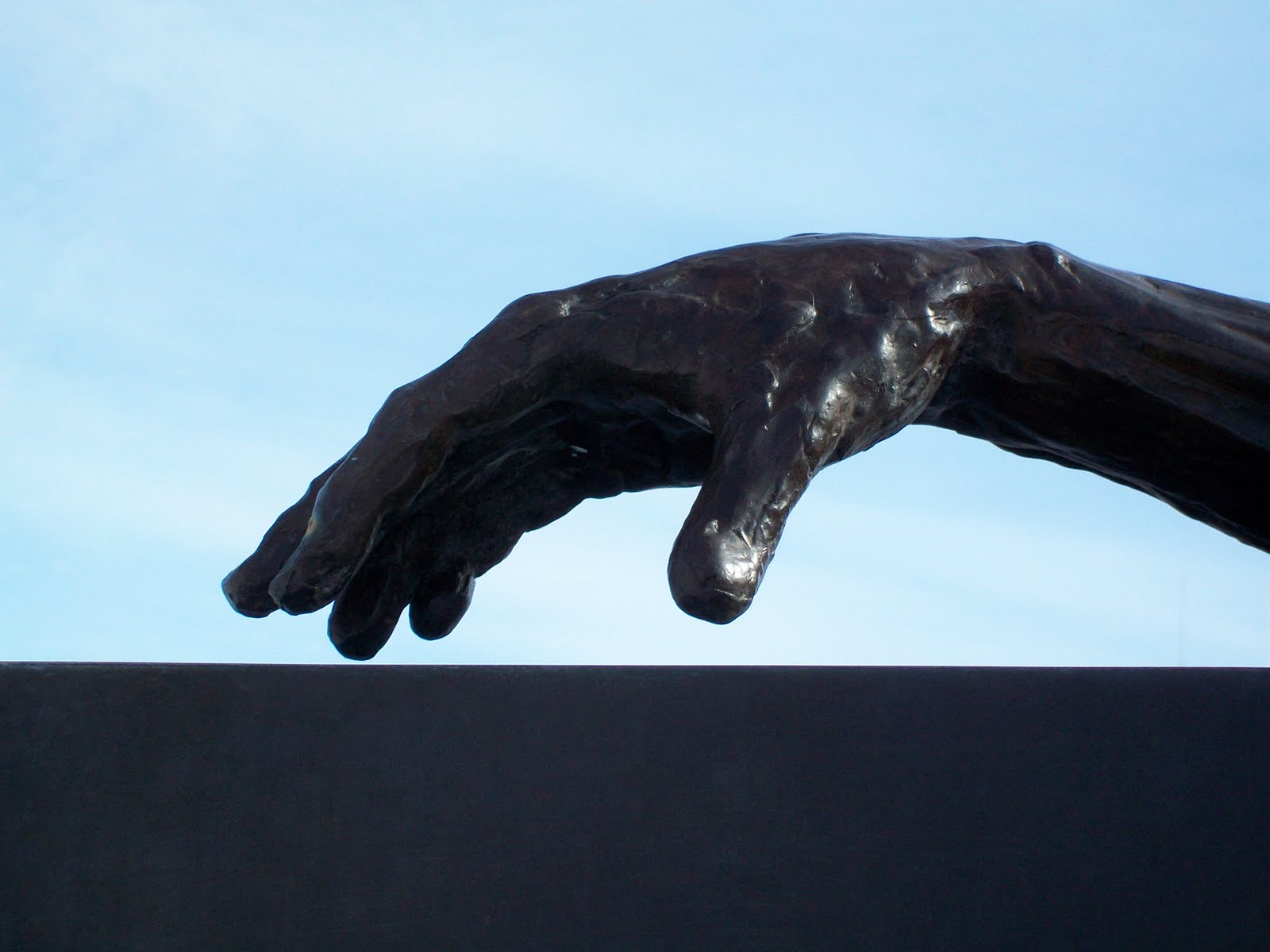
It really feels good to take the cast off of a broken arm or leg and experience a feeling of wholeness once again, and that's what this piece of sculpture talks about. The base of the sculpture is a circle, perfectly round, and represents eternity. And over here are these wonderful footprints, which represent God stepping into time and space in the form of Jesus Christ to live and to suffer and to die and to rise again for mankind. And over here you can kind of see a symbol of a cross. The depressed sections represent death, and they look like casts, body casts. And this whole three-dimensional form represents resurrection and new life. And I think the whole sculpture is made of blocky fragments that emphasize this breaking out like spring when little plants grow out of the ground.
The play of light on these blocky forms changes every day. So here's this object in the middle of the campus, it's always there, but it's never the same.
The Creation sculpture was built by Arthur Geisert.
This piece called The Creation is made out of hammered lead and over here you see the words of the narration of the creation from the book of Genesis. It's interesting that a piece of sculpture which represents God the Father is tucked away here by the music building on the edge of campus. God is not hidden, it is we who hide Him. And when we do that to creation, we rarely notice it and we take it for granted. And we need to be more and more aware of the wonders of these wonderful insects, plus all the magnificent things like galaxies and stars and mountains too.
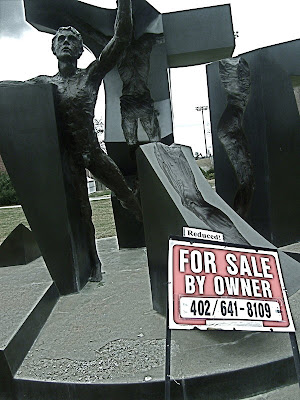 This first image was photographed by another Concordia student. This is her site. Last year, another student moved a for sale sign from someone's yard and placed it here. The artist saw this and found it humorous.